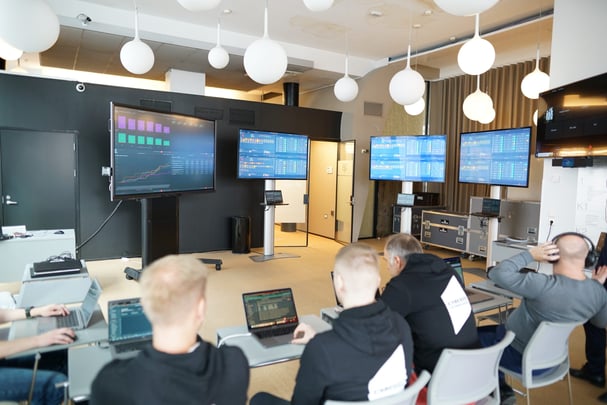
A cyber crisis is rarely lost on the technology alone. It is lost in the first hours, in the decisions about who to notify, what to shut down, and what to tell customers and the public. Yet in a 2025 survey of 480 senior cybersecurity executives, 80% said their teams do not get enough practice running real incident scenarios, and 57% had already faced an incident they had never rehearsed.
First of all, it is important to ensure that your team has enough experience and know-how to properly tackle various cyber challenges and ensure the security of your organization. In order to achieve that, management must provide their team members with tools and resources that will help them gain hands-on experience and understanding of the nature of a real attack. That's exactly where cyber crisis simulation technology is incredibly useful, and in this article, we will tell you all about the capabilities and benefits that this technology can bring to your organization.
What is a cyber crisis simulation?
Simply put, a cyber crisis simulation refers to a solution that helps organizations improve their security posture by simulating realistic cyber crisis scenarios and giving them the opportunity to overcome these challenges. This way, participants get the opportunity to experience and deal with different types of realistic simulated incidents, such as ransomware attacks, data breaches, phishing, and more.
One distinction is worth drawing early, because it is easy to miss. A crisis simulation is not a technical cyber range. A cyber range puts security engineers at keyboards, defending real systems against live attacks; it tests technical detection and response. A crisis simulation tests the people-and-process side of an incident: how executives, a crisis team, communications, legal, and IT liaisons assess an unfolding situation, make decisions, coordinate, and communicate under pressure. CybExer delivers this through its STRATEX platform, built for strategic exercises up to executive, ministerial, and even NATO Parliamentary Assembly level.
Cyber crisis simulation brings the approach that helps organizations achieve the following:
- Help the team experience cyber challenges in a safe environment
- Assess the participant's cybersecurity skills and overall posture
- Leverage realistic and industry-specific training scenarios
- Validate ideas to optimize existing security processes
Companies worldwide can achieve this through various existing cybersecurity exercises, which have different goals and objectives depending on the organization's current needs.
How a crisis simulation runs
A crisis simulation is built around a scripted but evolving scenario rather than a single event. On the STRATEX platform, that scenario is delivered as a stream of injects: news of a ransomware note, a journalist calling for comment, a regulator asking questions, a critical service going dark. Each inject forces a timed decision. Participants respond in their real organizational roles and through their normal channels, so the exercise rehearses the actual chain of command, not a hypothetical one.
Scenarios can combine cyber and physical events, which is closer to how real crises arrive. Exercise control staff run and monitor the session from the platform, and it captures and visualizes results as the exercise unfolds, so weak points surface in real time and feed a structured debrief afterwards. Because delivery is software-based, participants can join remotely and the exercise scales to large, geographically spread teams. Different simulation exercises help participants increase their decision-making speed, which is essential for minimizing loss in a crisis.
Benefits of Running a Cyber Crisis Simulation.
There are various use cases where organizations worldwide could use the help of technology like cyber crisis simulations in order to play out hyper realistic scenarios and test their team's cyber defense capabilities. This way, management can evaluate their organization's current level of security posture and point out the exact areas of development to boost their organizational cyber resilience.
Run Cyber Exercises in a Collaborative Manner
Cyber crisis simulation offers an opportunity to run different types of cyber exercises and gives your team a chance to get hands-on experience in dealing with intense cyber threats and attacks. With this approach, the team learns how to work together and improves their collaboration and communication skills, which is extremely important when they have to tackle real cyber challenges.
Measure Performance and Assess Security Posture
Cyber crisis simulation also allows organizations to conveniently optimize their technology stack and improve security processes. Generally, it can be challenging at times to properly validate the security stack. However, with the help of the crisis simulation technology, you can test and adjust existing incident response plans, helping you to be up-to-date with current security trends and practices.
Test New Technologies and Ideas in a Safe Environment
Another important factor in improving your cyber resilience is all about effective approaches to testing new ideas and technologies. Companies often face challenges when they want to update their security stack and validate new ideas in a cost-effective manner – it is generally expensive to pause production to test new approaches in your security stack. Simulated environments in the crisis simulation, on the other hand, enable decision-makers to assess new technologies in a realistic simulation environment and agree on the best option without having to interrupt any ongoing processes for their companies.
Evaluate Your Team's Skill Set and Identify Areas of Improvement
Cyber crisis simulation gives organizations a unique opportunity to assess their cyber readiness with realistic attack scenarios and identify areas of improvement. This process fosters cybersecurity education, training, and certification, which is an effective way for teams to boost confidence and enhance decision-making skills when they tackle real-world cyber challenges. Objectives can be mapped to each participant's development plan, so a single exercise doubles as an individual skills assessment.
Table Top Exercise vs Cyber Crisis Simulator
Tabletop exercises in cybersecurity refer to a more tactical set of activities that focus on the operational level of cyber preparedness management. Generally, companies organize these types of activities for Incident Response teams and stakeholders.
Cyber crisis simulator, on the other hand, has a more comprehensive approach to expose the participants in front of all the possible cyber challenges that organizations might have. The goal, in this case, is to educate staff with realistic simulations and boost their cyber resilience through the hands-on practical training approach.
Crisis simulator offers a type of cybersecurity training approach where a team has the opportunity to experience day-to-day challenges and prepare for potential sophisticated cyber threats and attacks on the highest level.
Real-world examples
To have a better overview of the outcomes and effects of a cyber crisis simulation, let's take a look at some real-life examples from CybExer Technologies, where this technology has proved to be extremely useful for training purposes.
Case study: Tapa Municipality
A good illustration of the format is a STRATEX exercise run for Tapa Municipality in Estonia. The scenario combined a major snowstorm that caused power outages and blocked roads with a cyberattack on municipal systems, forcing the participants to manage two crises at once. Around the table were the municipality's crisis team, the police, the rescue centre, and critical service providers, coordinating from their own locations rather than a single lab. The goal was not to defend a network but to test a newly completed emergency-response plan and the cooperation between agencies. As CybExer's Andrus Kivisaar put it, the run showed "how important it is to test crises response systems of municipalities," and surfaced the weak spots in those structures before a real event could. Read the full overview of this exercise.
Case study: Ukraine's public sector
In collaboration with e-Governance Academy, CybExer Technologies has been repeatedly supporting Ukrainian public stakeholders to empower their teams responding to various cyber threats and attacks. One of the examples of this activity include the exercise within the framework of the EU4DigitalUA project funded by the European Union in 2021 with the mission of boosting the participating Ukrainian public organization's cyber resilience. 50+ officials from Ukraine's State Service of Special Communications and Information Protection (SSSCIP), Ministry of Defense and National Bank (NBU), Security Service (SBU), and Cyber Police came together to experience this cyber simulation. The exercise aimed to equip participants with the necessary knowledge to prevent and respond to potential cyber threats. Read the full overview of this exercise.
Working with CybExer
As cybersecurity is becoming increasingly challenging for organizations worldwide, it is important to embrace innovative training solutions like cyber crisis simulations to ensure your organizational cyber resilience. At CybExer Technologies, we have been at the forefront of shaping the cybersecurity industry since 2016. We are committed to providing advanced technologies that help organizations improve their overall security posture. If you'd like to learn more about our offering, schedule a call with our cyber range experts to discuss your organization's needs.