Army Cyber Spartan: Live-Fire Cyber Training for the British Army
How CybExer supports the British Army's flagship live-fire cyber exercise year after year, on a permanent range used to train, experiment and validate throughout the year.
How CybExer supports the British Army's flagship live-fire cyber exercise year after year, on a permanent range used to train, experiment and validate throughout the year.
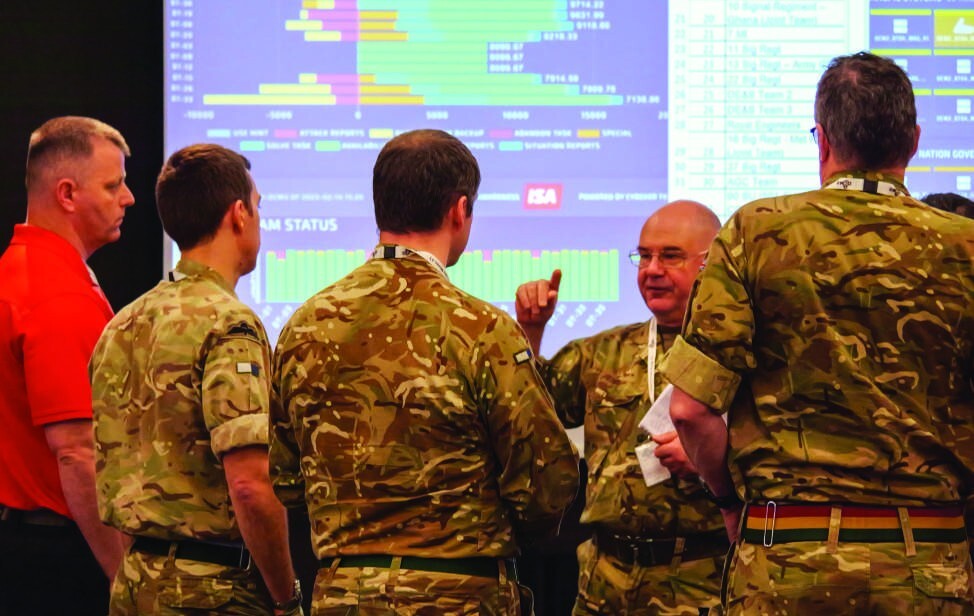
Army Cyber Spartan (ACS) is one of the British Army’s largest hands-on cyber exercises, run each year at the Defence Battle Lab in Dorset Innovation Park. Teams face realistic attacks in a controlled environment and have to detect, analyse and respond to them under pressure. It runs on an on-premise cyber range in the UK that the British Army owns and CybExer Technologies maintains, and 2026 marks CybExer’s seventh year of supporting the exercise.
The exercise is built to mirror the reality of a modern Security Operations Centre. Its main purpose is to test and improve the effectiveness of the SOCs that monitor and defend networks day to day, giving participants practical experience of identifying, analysing and responding to cyber incidents in real time.
Army Cyber Spartan 2024 brought together more than 350 participants, working alongside cyber range engineers, red team operators, user-simulation experts and exercise controllers to create a dynamic, believable training environment. Across 33 teams, participants worked in a live-fire cyber environment, responding to simulated attacks as they would in the real world. They developed skills in threat hunting, detection, analysis and mitigation, improved coordination within and between teams, and practised how to generate, analyse and act on cyber threat intelligence.
Performance is measured across several dimensions rather than a single score. Live-response effectiveness captures how well teams react to simulated attacks. Threat detection and monitoring reflects their ability to identify attack patterns and vulnerabilities. Incident analysis and reporting rewards structured decision-making and clear intelligence sharing. And team coordination and interoperability measures how well people collaborate, both within a team and across organisations. Together, these give a rounded picture of readiness that goes well beyond whether an attack was stopped.
Performance is assessed team by team against that consistent framework, and what the exercise delivers is large-scale, realistic practice against a live adversary, the kind of experience that translates directly to real-world operations.
The live-fire format is central to why the exercise works. A live-fire exercise is designed to help professionals simulate and practise defending against real-world cyber threats, bringing an entire team together to rehearse the technical skills involved in responding to incidents. It is built around red team versus blue team dynamics, with defenders working against an adversary that is actively trying to outmanoeuvre them.
That realism is what separates a live-fire event from a tabletop discussion. Teams are not talking through what they would do in principle. They are doing it, in real time, while the situation shifts around them, which is precisely the pressure a real incident brings. It is also why an environment as large and as faithful as Army Cyber Spartan needs a purpose-built cyber range underneath it.
Army Cyber Spartan is a recurring exercise. It runs year after year, and each edition builds on the last.
The 2023 exercise, held from 20 to 24 November at the same Defence Battle Lab, set the pattern. It gathered 320 personnel across 32 blue teams from six nations, supported by 15 industry partners, and ran in four phases: introductory training to learn the environment and the rules of engagement, a threat-hunting phase focused on detection without active response, a live-fire phase pitting teams against a red team, and a reconnaissance phase spent gathering intelligence on the adversary’s strategies.
The exercise has grown year on year: from 320 participants and 32 teams in 2023 to more than 350 participants and 33 teams in 2024. It ran again in 2025, and the next edition, ACS 27, is scheduled for January 2027, all on the same Army-owned cyber range. The emphasis on realism and the core structure carry across each edition, which is part of the point: a recurring exercise that teams return to, building on what they learned the year before.
The exercise is designed around a clear set of goals. First among them is strengthening defensive cyber operations and the effectiveness of the SOCs at their heart. Beyond that, the aim is to deliver ambitious, challenging and realistic scenarios, to strengthen relationships within Defence and with governmental and international partners, and to foster international cooperation and the sharing of best practice. The exercise also goes beyond pure technical performance, building teamwork, refining procedures and developing the professional relationships that matter when a real incident strikes.
Army Cyber Spartan is the British Army’s exercise: the Army sets the training objectives and runs the event, while CybExer provides the technology and expertise behind it. Those roles rest on a permanent capability. The British Army owns an on-premise cyber range in the UK, and CybExer maintains it, so the platform is available all year rather than only for the annual exercise.
That permanence shapes how the range is used. Beyond the large-scale ACS exercises, the Army works on it throughout the year to self-train, to experiment with new tools and techniques, to integrate systems and to validate them before they are relied on. CybExer delivers that year-round capability alongside the annual training and the exercises themselves, and since 2023 it has done so as the prime and sole supplier.
For the exercise itself, the platform supports hundreds of participants at once in a scalable, realistic environment whose structure is mapped to recognised industry frameworks, so that the experience translates directly to real-world cyber defence. Running an event on this scale takes more than software: it calls for the ability to stand up a realistic, believable game network, to coordinate red, blue and white team activity, and to keep hundreds of participants productively engaged at once. That is what CybExer’s experience in large-scale exercises brings.
“ACS demonstrates the Army’s ability to deliver defensive cyber training and assessment at scale. The exercise structure is mapped to recognised industry frameworks, ensuring participants gain valuable experience that translates to real-world cyber defence.”
Mansel Thewlis, ACS 2024 Lead Organiser

Army Cyber Spartan runs as a live-fire exercise, with teams responding to attacks in real time.
An exercise on the scale of Army Cyber Spartan lets the Army rehearse against realistic, adaptive attacks at a scale that smaller drills cannot reach, and repeat that practice so that skills are maintained and improved rather than tested once and forgotten.
“The symbiotic relationship between CybExer and my organisation has provided a proven platform for success, year after year.”
Captain D Preuss, British Army
The value is not only technical. By bringing together serving personnel, industry partners and, in the 2023 edition, teams from several nations, the exercise builds teamwork, refines procedures and strengthens the professional relationships and international cooperation that matter most when a genuine crisis arrives. Those are exactly the connections that cannot be improvised under fire, and that a recurring exercise is well placed to develop over time.
Army Cyber Spartan shows what large-scale, live-fire cyber training looks like when it is sustained over time. Delivered on a cyber range the British Army owns and CybExer maintains, it turns a demanding annual event into repeatable, improving practice, sustained across the 2023, 2024 and 2025 editions and continuing with ACS 27 in 2027, and helping defenders keep pace with a fast-changing threat landscape.