.jpg?width=624&height=405&name=ai-core-shifted%20(1).jpg)
Digital twin AI validation is the practice of testing an AI system inside a high-fidelity virtual replica of its real environment — under genuine adversarial and operational conditions — rather than against static benchmarks. The aim is to prove, with evidence, how the whole system behaves under pressure — the model together with the agents, tools, APIs, data access and identities around it — before it is trusted in production.
It has become necessary because AI fails differently from conventional software: the same model responds differently to a rephrased instruction, degrades as live data drifts from its training distribution, and gives way under deliberate manipulation — failure modes that a benchmark score, measured once on fixed test data, never reveals. Exercising the model inside a genuine replica, under realistic and hostile conditions, is how those AI behaviours are exposed safely — and the threat and governance frameworks are converging on exactly that expectation.
Why Theoretical Validation Falls Short for AI
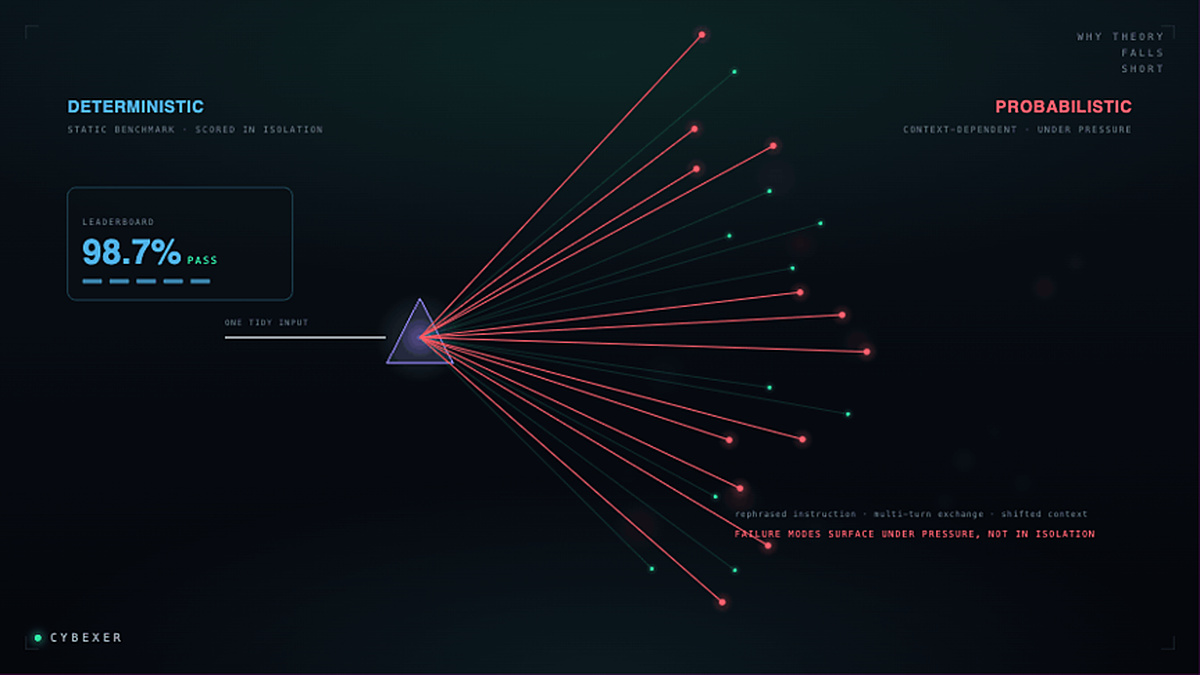
Conventional software is validated against deterministic correctness: a given input should produce a defined output, and a test passes or fails. AI does not work like that. Its outputs are probabilistic and context-dependent — the same system answers differently to a rephrased instruction, a multi-turn exchange, or a small shift in context. Static benchmarks struggle to cover that ground, because the failure modes are not fixed test cases; they surface under pressure.
The industry's own risk catalogues make the point. The OWASP Top 10 for LLM Applications (2025) puts prompt injection at number one for the second edition running, data and model poisoning at four, and excessive agency — an agent overreaching once manipulated — newly at six. None of these is about whether a model gives the right answer in isolation; each is about how it behaves when someone actively engages. Guardrails and traditional testing can assess many aspects of an AI solution, but only testing within a mirrored instance of your production enterprise reveals how it will truly behave under real-world conditions.
Agentic systems raise the stakes again. Give a model tools and autonomy, and a single manipulated output can cascade into a chain of actions across systems — prompt injection becomes tool misuse, poisoned context steers decisions, and the trust boundary between agents turns into an attack surface.MITRE's ATLAS knowledge base, the AI counterpart to ATT&CK, now catalogues 16 adversary tactics and more than 80 techniques against AI systems — training-data poisoning, model evasion, RAG poisoning, AI supply-chain compromise — all drawn from real cases. These are the behaviours a serious validation effort has to provoke and watch for, and a benchmark surfaces almost none of them.
What a Digital Twin Brings to the Problem
A digital twin is a virtual replica of real systems, networks, and data — faithful enough to behave like the original, but built to be probed, attacked, and broken with nothing in production at risk. They run from exact replicas of a single complex system, such as a satellite or an industrial controller, to representative copies of many similar components, such as a fleet of endpoints or a city's sensor network.
For AI assurance, that fidelity is the missing piece. A digital twin gives a model an environment that behaves like the real one — authentic data, background activity, the ambiguity it will actually meet — where it can be put under live adversarial pressure, safely and repeatably, with every action observable. Building a replica to that standard, genuine enough that the model cannot tell it from production changes the test itself, from a demonstration that an AI behaves under cooperative conditions into a real attempt to break it under hostile ones.
The Role of Digital Twins in AI Assurance
AI assurance is the discipline of establishing, with evidence rather than expectation, that an AI system behaves safely, securely and reliably once it is doing real work — and of doing so continuously, not at a single point of sign-off. A passing benchmark or a clean sandbox run speaks to how a model performs under cooperative conditions; assurance is concerned with how it holds up under hostile and unpredictable ones, and with being able to demonstrate that to a board, an auditor or a regulator. Meeting that demand for evidence is what a digital twin is positioned to do.
Within that lifecycle, a digital twin contributes in two distinct ways:
· Before deployment — as a controlled proving ground, where a model is tested and red-teamed against realistic adversarial conditions and exact replicas of your production environment, rather than fixed benchmarks in a basic template test setting, resulting in weaknesses being surfaced in a contained environment instead of in production.
· After deployment — as a continuing reference environment, where new threats and production-like activity are replayed on a defined cadence, so that model drift or a newly discovered weakness is identified as a finding rather than experienced as an incident.
While security is the most pressing case, the same environment supports the wider assurance picture. Exercising a model under realistic load reveals its reliability and latency; exposing it to the genuine edge cases of a live environment tests its robustness and its behaviour as data drifts from the distribution it was trained on. A single faithful environment can therefore address several assurance objectives at once, rather than requiring a separate exercise for each.
This is also where the rules are heading. The NIST AI Risk Management Framework puts testing and evaluation at the centre of trustworthy AI, and its 2024 Generative AI Profile calls explicitly for adversarial testing — red teaming under stress — alongside metrics, acceptance thresholds and a set retest cadence; the EU AI Act points the same way for high-risk systems; and ISO/IEC 42001, the management-system standard for AI, expects continuous evaluation and monitoring. Increasingly, assurance is demanded as an assurance case: a documented, evidence-backed argument that a system can be trusted.
What none of these frameworks supply is the place to do the work. Red teaming an AI system under realistic, repeatable conditions needs an environment that behaves like production but contains the consequences — especially when the model under test may act unpredictably or has been deliberately compromised. A digital twin, isolated and instrumented, is that place.
From Benchmark to Live-Fire: What You Can Actually Test
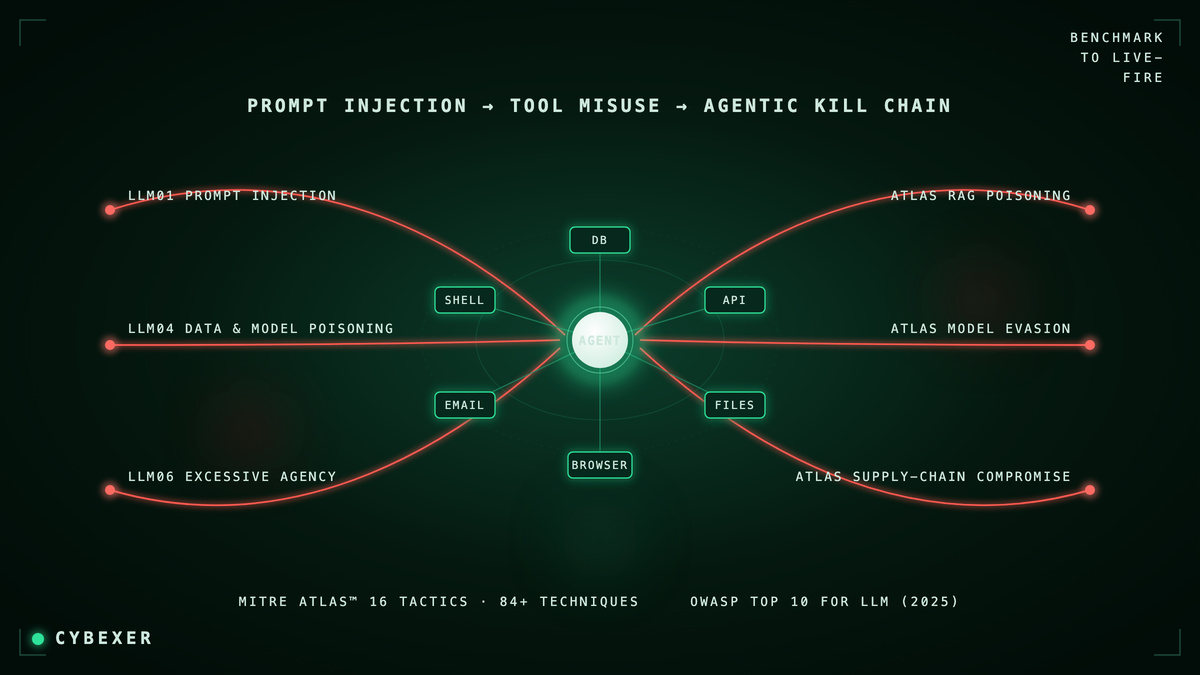
Once a model sits inside a faithful twin under adversarial pressure, the risks catalogued by OWASP and ATLAS stop being theoretical and become things you can exercise directly:
· Prompt injection and multi-turn manipulation against tool-using agents — whether guardrails hold across a sustained, adaptive conversation rather than a single prompt.
· Data and model poisoning — how the system behaves when the model or its training data has been tampered with, a class of failure that only a contained, isolated environment can safely reproduce.
· Excessive agency and agentic kill chains — what happens when an attacker chains interactions or poisons retrieved context to turn one foothold into many across the tools an agent can reach.
· Adversarial AI in the loop — pitting offensive and defensive AI against each other, and against human teams to see how autonomous systems behave when the adversary adapts as quickly as they do.
· Resilience under realistic noise — whether the model's judgement survives the legitimate traffic and business logic of a real environment, not the clean inputs of a test harness.
This is the line between confirming an AI works and proving it is resilient. The first is a lab exercise; the second needs an environment realistic enough that the model cannot tell it is being tested, and an adversary capable enough to find the seams. That testbed increasingly extends to deliberately manipulated or poisoned models — a failure class invisible to conventional evaluation, and one platforms reproduce inside contained replicas precisely because it cannot be examined any other way.
Evidence, Not Impressions
Live-fire validation is only as good as what you can measure from it. The value lies in capturing, in detail, how a system held up under attack — where it stood firm, where it was manipulated, how fast — and being able to replay it. Real-time instrumentation is what turns an exercise into evidence rather than an impression, and what lets the same model be retested as threats change — a continuous obligation the frameworks recognise, not a one-off.
Where It Matters Most
The case for digital-twin validation is sharpest wherever AI meets high-consequence systems — critical infrastructure, space, finance, and connected urban environments, where a manipulated model has physical or systemic reach. Some of this is already operational: digital twins of industrial control systems let operators rehearse attacks against their own plants, and CybExer's work on the European Space Agency's Space Cyber Range replicates satellite systems faithfully enough to test attack and defence before launch. The principle is constant — the higher the stakes of an AI decision, the less defensible it is to validate it in theory alone.
How to Approach AI Validation on a Digital Twin
A few principles separate genuine assurance from a more elaborate demonstration:
· Fidelity decides everything. A twin that only loosely resembles your environment produces behaviour that will not transfer; insist on a replica faithful to your real topology, data, and tooling.
· Map tests to a real threat model. Use ATLAS and the OWASP LLM risks to define what you provoke, rather than improvising prompts.
· Make the adversary adaptive. Test against automated, evolving adversary activity — including AI-driven attackers — not a fixed script the model can learn to pass.
· Validate before and after deployment. Models drift and threats change; continuous adversarial testing is what keeps assurance current.
· Instrument and contain. If you cannot replay how the model behaved, you have an impression; and testing compromised models demands an environment that holds them safely and meets your regulatory obligations.
What a Digital Twin Can't Tell You
A digital twin is not a guarantee, and its limits are worth stating plainly. A twin is only as good as its fidelity: a loose replica produces behaviour that will not transfer, and a poorly built one can give false assurance, which is the most dangerous outcome of all. Building and maintaining a true replica takes real effort, and no twin reproduces everything — genuine user behaviour at full scale, and wholly novel attacks, will still exercise a model in ways the replica did not anticipate. A twin narrows the gap between test and reality rather than closing it, which is the deeper reason assurance must be continuous rather than a single verdict.
From Confidence to Evidence
Theoretical validation produces confidence; a digital twin produces evidence. As AI takes on more of the decisions that determine whether an attack is caught, the standard has to rise with it — from a model that scored well in the lab to one shown to hold up under fire in a faithful replica of the real thing. That is the shift the frameworks now expect: not proving an AI can pass a benchmark but finding where it breaks before it impacts your production environment or is exploited by an attacker.
If you are putting AI into security-critical workflows, we would be glad to discuss how our validation methods could fit your requirements.