AI assurance platforms are the tools organisations use to demonstrate that their AI systems are trustworthy: reliable, fair, secure and aligned with a fast-growing body of AI regulation. As enterprises adopt AI more widely, and as rules such as the EU AI Act take effect, these platforms have become a common way to govern AI risk and to produce the evidence that auditors, regulators and boards increasingly ask for.
The category is still taking shape, spanning everything from governance and documentation systems to model-evaluation and monitoring tools. What they share is a common purpose: giving an organisation a clear, evidence-based account of the AI it runs, and the ability to substantiate that account on demand. What follows sets out how these platforms work, how to weigh one against another, where their evidence stops, and when realistic environment testing is needed.
This guide anchors its discussion in European rules, mainly the EU AI Act and the Cyber Resilience Act. The issues, though, are not limited to Europe. The UK has built a dedicated AI assurance ecosystem around DSIT's roadmap and portfolio of assurance techniques. In the US, requirements are emerging state by state. South Korea's AI framework act took effect in January 2026. What an assurance platform can show, and what it cannot, is the same whether the rulebook comes from Brussels, London, a state legislature or Seoul.
What an AI assurance platform is
An AI assurance platform is the software an organisation uses to keep continuous, evidence-based confidence that its AI systems are working as intended and staying within acceptable risk. In practice it does four things: it discovers and inventories the AI in use; it assesses and classifies the risk of each system; it checks behaviour and controls against defined policies and external frameworks; and it keeps the evidence that all of this was done. The aim is a single, inspectable source of truth for AI risk that an auditor, a regulator or a board can rely on.
Three terms are often used loosely and are worth separating. Assurance is the continuous activity of demonstrating trustworthiness. Governance is the wider framework of policies, roles and controls that decides how AI may be built and used. Audit is a backward-looking check of whether a system was compliant at a given point in time. Assurance is the connective tissue between them, the ongoing, evidence-producing work that shows a system is trustworthy now and likely to stay that way. In commercial tooling, “assurance” and “governance” platforms overlap heavily, so the capabilities matter more than the label. The category also overlaps with what industry analysts call AI trust, risk and security management (AI TRiSM) and, in financial services, with long-established model risk management practice. This guide deliberately names no vendors: the market is moving too fast for any list to stay accurate, and the capability layers described below are a more durable guide than any current product list.
What AI assurance platforms cover
Mature AI assurance platforms do a great deal, and it helps to separate the operational mechanics they run on from the risk areas they address. The mechanics are the backbone that most platforms share:
· Discovery and inventory, including shadow and third-party-embedded AI
· Risk and impact assessments, mapped to the EU AI Act's risk tiers
· Policy management and framework mapping (EU AI Act, ISO/IEC 42001, NIST AI RMF)
· Drift and performance monitoring, incident management, and change or version management
· Audit-ready evidence: model cards, impact assessments, vendor risk ratings and control evidence
Underneath sits a maturing standards layer. ISO/IEC 42001 defines a certifiable management system for AI governance, while the NIST AI Risk Management Framework offers a voluntary structure built around four functions: Govern, Map, Measure and Manage. Both organise and evidence risk work, and AI assurance platforms are, in large part, the machinery for satisfying them.
Beyond those mechanics, the substance of assurance sits in several distinct risk areas. In each, platforms do substantive work; in each, there is a limit to what automated checks can establish on their own.
Bias and fairness
Platforms test models for biased outcomes across groups, run fairness metrics and flag disparate impact, then record the results for audit. What they cannot fully settle is whether a metric that looks fair in testing stays fair in a live population that shifts over time, or whether the fairness definition chosen actually matches the legal and ethical standard that applies to the use case.
Privacy and data protection
They check for exposure of personal data, support data-minimisation and consent controls, and map processing against obligations such as the GDPR. The harder questions sit outside a dashboard: whether a model has memorised training data and can be induced to reveal it, and whether data flows behave as documented once the system is wired to real sources and downstream tools.
Explainability and interpretability
Platforms attach explanations to model decisions, generate feature-importance views and produce model cards describing intended use and limitations. The limit is that an explanation can be plausible without being faithful to how the model actually reached its output, and explanations for large generative and agentic systems remain an open research problem rather than a solved feature.
Data governance and lineage
They track datasets, versions and lineage, and tie each model to the data it was trained and evaluated on, which is essential for reproducibility and audit. What tooling records is provenance as declared; it does not, by itself, prove that upstream data was lawfully sourced, correctly labelled or free of contamination, which usually needs process controls and, at times, independent review.
Human oversight and accountability
Platforms document oversight roles, approval steps and escalation paths, and evidence that a human was in or on the loop. Whether that oversight is meaningful under real conditions is a separate matter: whether reviewers have the time, information and authority to override the system when it counts, and whether accountability holds when an automated decision goes wrong, are organisational questions a control register can describe but not guarantee.
Supply chain and third-party models
They assess vendors, inventory third-party and foundation models and record risk ratings, which matters as more capability is bought rather than built. The gap is the depth of assurance possible over components an organisation does not control: the behaviour, training data and security of a third-party model are often opaque, so vendor attestations and contractual terms end up carrying weight that first-hand testing would otherwise provide.
The pattern repeats across every dimension: assurance platforms are strong at organising, documenting, monitoring and structured evaluation, while the residual risk is behavioural and contextual, and it surfaces only when the system is running, not when it is being documented.
The AI assurance capability landscape
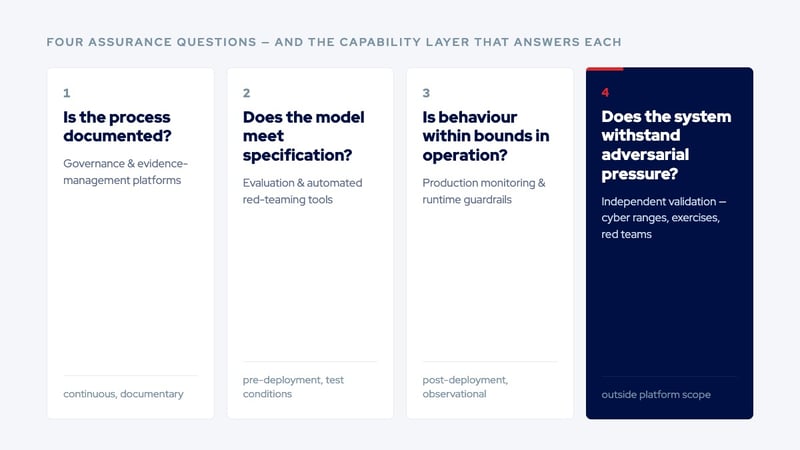
It helps to think in capability layers rather than one flat category. Most products live mainly in one layer and reach into the others.
· Governance and evidence management. AI system discovery and inventory, risk and impact assessments, policy management and framework mapping, and audit-ready documentation. This is the home of governance-first platforms, GRC suites and the assurance services of large consultancies.
· Model and application evaluation. Bias and robustness testing, LLM and agent evaluations, and increasingly automated adversarial testing such as prompt injection, jailbreaks, tool misuse and multi-agent exploitation. Some governance platforms now market continuous adversarial testing inside the product; others run structured synthetic scenarios to map a model's operating boundaries.
· Production monitoring and intervention. Monitoring live models and agents for drift, anomalous access, policy violations and unsafe behaviour, with guardrails that intervene at runtime.
· Independent system and environment validation. Reproducing the wider operational environment, meaning the infrastructure, security tooling, business processes and human teams around the AI, and watching how the AI behaves within it under adaptive attack. This is the cyber-range layer.
The first three layers are largely software-only and increasingly capable, so it is simply wrong to say AI assurance platforms cannot do adversarial testing. The distinction that matters most here is the fourth layer, which none of the first three provides on its own.
|
Capability layer |
What it does well |
What it does not reproduce |
|
Governance and evidence management |
Inventory, risk and impact assessments, policy and framework mapping, documentation |
Any live system behaviour |
|
Model and application evaluation |
Bias and robustness, LLM and agent tests, prompt-injection, jailbreak and tool-misuse testing |
The surrounding environment, security controls and human teams |
|
Production monitoring and intervention |
Drift, anomalies, policy violations and runtime guardrails in production |
Controlled, repeatable adversarial scenarios before go-live |
|
Independent system and environment validation |
Model, tools, controls and people under sustained, adaptive attack, with instrumented evidence |
A universal guarantee of trust; results are bounded by test conditions |
How to choose an AI assurance platform
Because the label spans several layers, choosing an AI assurance platform is really about matching the layers you need to the obligations and risks you actually face. A few questions separate the options:
· Which layers does it cover? A governance-first tool may need pairing with an evaluation or testing capability, and the reverse is equally true.
· Does its framework mapping match your obligations? Look for direct mapping to the EU AI Act, ISO/IEC 42001 and the NIST AI RMF, and to sector rules such as NIS2 or DORA where they apply to you.
· How deep is its evaluation? Bias and drift checks are common; adversarial coverage such as prompt injection, jailbreak and tool-misuse testing varies widely between products.
· How usable is the evidence? Audit-ready artefacts such as model cards, impact assessments and control evidence should be exportable and mapped to the frameworks your auditors already use.
· How well does it integrate and monitor? It should discover shadow and third-party AI and watch models and agents in production, not only at review time.
· Where should independence sit? Some assurance is fine in-house; some evidence carries more weight when it is independent of the team that built the system.
Selection is therefore less about finding one best platform than about assembling defensible coverage: identifying which combination of layers suits a given risk profile, and where capability beyond software-only tooling will still be required.
Assurance for agentic AI
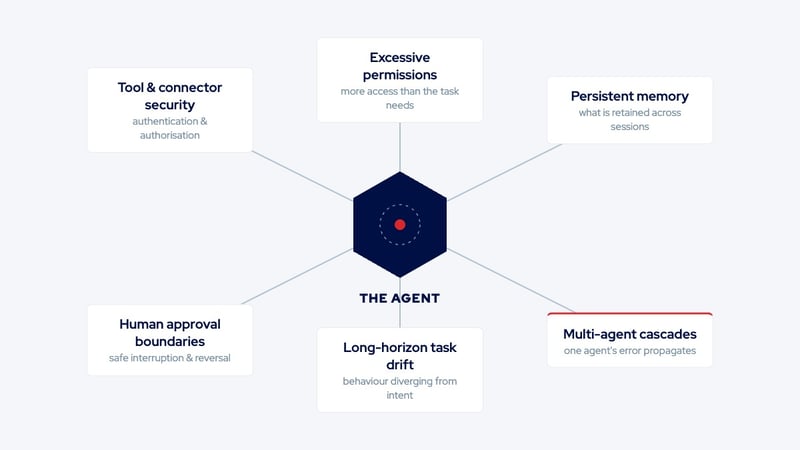
AI agents raise assurance questions that model-level testing does not fully cover, because an agent acts: it calls tools, holds memory and pursues goals over many steps. Alongside the model itself, an assurance programme has to account for:
· Tool authentication, authorisation and connector security, so that an agent can only use the tools, data and integrations it is entitled to
· Excessive permissions, where an agent accumulates more access than its task actually requires
· Persistent memory, and what an agent retains, exposes or acts on across sessions
· Long-horizon task drift, where behaviour diverges from intent over extended, multi-step tasks
· Human approval boundaries and safe interruption, meaning which actions require a person in the loop and how an agent is stopped and its actions reversed
· Multi-agent coordination and cascading failures, where one agent's error propagates through others
Most of these are behavioural and environmental rather than static properties of a model, which is why agentic systems lean hardest on the fourth capability layer.
Assurance is not certification
What an assurance platform establishes is easily overstated. Several distinctions need to be drawn precisely:
· Framework mapping is not certification. Mapping controls to the EU AI Act or to a standard organises your evidence; it does not, by itself, certify anything.
· “Audit-ready” does not mean accepted. Well-structured evidence still has to satisfy a real auditor or regulator, who may ask for more.
· Using an assurance platform does not establish EU AI Act compliance. Compliance rests on meeting the legal obligations, not on operating a particular tool.
· ISO/IEC 42001 certification concerns a management system, not a model. It shows you run a sound AI governance system; it does not certify that every AI model or system is safe.
The certification machinery itself sits elsewhere. For high-risk systems, the EU AI Act delivers its verdict through conformity assessment: internal control against harmonised standards for most Annex III systems, or review by a notified body where the Act requires one, followed by an EU declaration of conformity and CE marking. The harmonised standards being drafted by CEN and CENELEC's joint technical committee (JTC 21) are the benchmark much of this evidence will ultimately map to, and their delay is the main reason the high-risk deadlines moved to 2027 and 2028. A platform can assemble the technical documentation a conformity assessment consumes; the assessment itself is a separate, legally defined step.
In short, these platforms help you build and organise the case for trustworthiness. They do not deliver the verdict.
Independence and the credibility of evidence
Who produces the evidence affects how much weight it carries. Self-assessment and internal testing are often adequate for lower-risk, internal systems, and they are usually where a programme starts. Independent evidence, produced by a party separate from the team that built or operates the system, tends to matter more as the stakes rise, for example:
· Safety-critical and critical-infrastructure deployments
· Regulated systems where a supervisor or auditor will review the evidence
· Supplier and procurement acceptance, where a buyer needs assurance about a third party's AI
· Board-level risk decisions, where independence supports accountability
The practical rule is proportionality: the higher the consequence of failure, the stronger the case for independent, instrumented evidence rather than self-reported results.
What AI assurance platforms can't test: the evidence gap
The gap is not adversarial testing as such. It is the operational context. A model evaluation, however sophisticated, probes the model. It rarely reproduces the messy whole: the model connected to live tools and data, behind real security controls, run by real people, while an adaptive attacker works patiently over hours.
Why that whole matters is the theme of ENISA's July 2026 paper, ENISA's view on Cybersecurity in the Frontier AI Era. Citing industry sources rather than its own study, ENISA describes attackers weaponising newly disclosed flaws within about 15 minutes, and a median time from initial access to data exfiltration of roughly 72 minutes, with the gap between discovery and weaponisation “approaching zero.” The point ENISA draws from CERT-EU matters most for testing: the danger of the latest models lies less in the sheer volume of flaws they surface than in their ability to chain findings across steps, reason about application logic and produce working exploitation paths. In CERT-EU's words, that is “what turns a list of individual flaws into a working attack.”
Chained, environment-dependent behaviour carries a hard consequence. You cannot fully capture it with a scan, a benchmark or a question set. You have to watch the system operate. Three things in particular tend to fall outside software-only evaluation:
· How a model or agent behaves under live, adaptive attack as part of a wider system, rather than against a predefined task list
· Whether an AI-enabled security product helps or hinders against real, evolving attack traffic
· Whether the people and processes around the AI cope when it fails, errs or becomes the target itself
How EU regulation is reshaping assurance obligations
The obligations behind AI assurance are not uniform, and much commentary blurs very different audiences. Article 55 of the EU AI Act is not a general red-teaming duty for every enterprise using AI: it applies to providers of general-purpose AI models classified as presenting systemic risk. The Cyber Resilience Act binds manufacturers of products with digital elements, not every organisation running an internal AI application. The table maps the main questions to who is actually on the hook.
|
Regulatory question |
Primary regulated party |
Evidence expected |
Potential role for a range |
|
Systemic-model capability (AI Act Art. 55) |
GPAI model provider (systemic risk) |
Model evaluations, adversarial testing incl. red teaming, risk mitigation reported to the AI Office |
Advanced capability testing |
|
High-risk system security (AI Act Arts. 9 to 15) |
High-risk system provider |
Risk management, robustness and cybersecurity evidence |
System-level validation, where proportionate |
|
Deployer duties for high-risk systems (AI Act Art. 26) |
High-risk system deployer |
Human oversight, monitoring, logging, informing affected persons |
Exercising oversight and response under realistic conditions |
|
Transparency and content labelling (AI Act Art. 50) |
Providers and deployers of interactive or generative AI |
User disclosure, deepfake labelling, machine-readable marking of AI-generated content |
Minimal; mainly product and documentation controls |
|
Product vulnerability handling (CRA) |
Product manufacturer |
Secure development and vulnerability reporting |
Product and integration testing |
|
Operational readiness |
Enterprise operator |
Usually driven by NIS2, DORA, contracts or internal risk |
Team and process exercises |
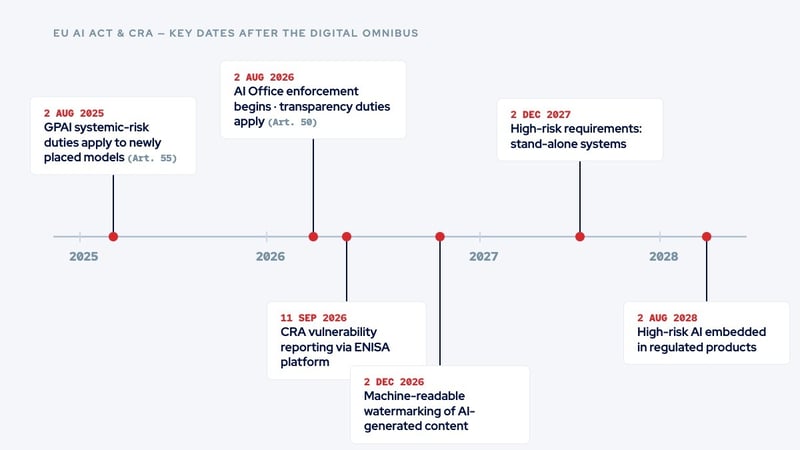
For systemic-risk models (broadly, those trained above 10^25 FLOPs), Article 55 requires providers to assess and mitigate systemic risks including large-scale cyberattack risks, perform adversarial testing including red teaming, and report to the European AI Office. In practice, most providers demonstrate this through the General-Purpose AI Code of Practice, whose Safety and Security chapter sets out what model evaluation and adversarial testing are expected to involve. The obligations have applied since 2 August 2025 to models newly placed on the market, with models already on the market before that date generally given until 2 August 2027. From 2 August 2026 the AI Office can investigate, require mitigations and impose fines of up to 3% of global annual turnover or €15 million, whichever is higher. For high-risk systems, Articles 9 and 15 set out risk-management, robustness and cybersecurity requirements, on a revised timeline set by the Digital Omnibus on AI, formally adopted by the European Parliament and the Council in June 2026: broadly 2 December 2027 for stand-alone systems and 2 August 2028 for AI embedded in regulated products.
Not every deadline moved. The Act's transparency obligations under Article 50, which require telling people when they are interacting with an AI system and labelling deepfakes and other synthetic content, still apply from 2 August 2026. Only the machine-readable watermarking duty for AI-generated content was deferred, to 2 December 2026, and the same amendment added a new prohibition on AI systems designed to generate non-consensual intimate imagery or child sexual abuse material, applying from the same date. For most enterprises deploying generative or interactive AI, transparency evidence is therefore the nearest-term AI Act artefact an assurance programme has to produce, not a 2027 problem.
The Cyber Resilience Act adds security-by-design and vulnerability-handling duties for products with digital elements; from 11 September 2026, manufacturers report actively exploited vulnerabilities through ENISA's Single Reporting Platform, with a 24-hour early warning, a 72-hour notification and a final report within 14 days of a fix being available.
What none of these rules settles is how to prove cyber capability realistically. ENISA's frontier-AI paper suggests it “may be useful” to build EU-wide benchmarks including standardised testing against cyber ranges, exploitability metrics and simulations of chained attacks; and on 7 July 2026 the Commission's EU Action Plan on Cybersecurity and Artificial Intelligence committed ENISA and the Commission's Joint Research Centre to a shared secure platform for testing AI in cybersecurity using simulated environments, alongside an EU capacity to evaluate advanced models before market. The direction is toward instrumented, comparable evidence produced in controlled environments, some shared and public, some private.
Where cyber ranges complement AI assurance platforms
AI assurance platforms are well suited to governance, structured evaluation and production monitoring. They do not always reproduce the wider operational environment in which an AI system interacts with infrastructure, tools, security controls and people.
Cyber ranges address this narrower evidence gap by providing controlled and repeatable environments for observing behaviour under realistic attack conditions. They can be used to test how an AI system or AI-enabled security product responds to chained attacks, how well surrounding controls perform, and whether teams can detect, contain and recover from failures.
The strength of this evidence depends on several factors, including environment fidelity, threat coverage, repeatability, evaluator independence and the relevance of the scenarios to production.
CybExer provides cyber-range and digital-twin capabilities for organisations seeking an additional layer of validation. If realistic environment testing forms part of your assurance plans, contact our cyber range experts to discuss what an appropriate setup could look like.
Frequently asked questions
What do AI assurance platforms actually test, and can they do adversarial testing?
Mostly structured or static properties: model accuracy, bias and fairness, robustness to varied inputs, drift and performance in production, and alignment with defined policies and frameworks, backed by strong inventory, documentation and continuous oversight. Increasingly they also run automated red-teaming, including prompt-injection, jailbreak and tool-misuse testing, so the limit is context rather than capability: they test the model, but rarely the model inside its real environment of connected tools, security controls and human teams under sustained attack.
What is the difference between AI assurance and AI governance?
Governance is the framework of policies, roles and controls that decides how AI may be built and used. Assurance is the continuous, evidence-producing activity that shows a system is trustworthy now and likely to stay that way. Most commercial tools blend the two, so it is more useful to compare capabilities than labels.
How do you choose an AI assurance platform?
Match the capability layers to your obligations and risk. Check which layers it covers, whether its framework mapping fits the rules you face, how deep its evaluation and adversarial testing go, how usable and exportable its evidence is, how well it integrates and monitors production, and where independent assurance is needed. Few programmes are well served by a single tool.
Do AI assurance platforms make you compliant with the EU AI Act?
They cover much of what the Act expects on governance and documentation: risk classification, impact assessments, policy mapping and audit-ready evidence. But Article 55 requires adversarial testing, including red teaming, for general-purpose models with systemic risk (with the GPAI Code of Practice setting out what that testing should involve), and Articles 9 and 15 require robustness and cybersecurity testing for high-risk systems. That dynamic testing usually happens outside the assurance platform, which makes the platform necessary but not sufficient.
When do the EU AI Act high-risk requirements apply?
Under the Digital Omnibus on AI, formally adopted in June 2026, they apply broadly from 2 December 2027 for stand-alone high-risk systems and from 2 August 2028 for high-risk AI embedded in already-regulated products. Not everything moved: the Article 50 transparency obligations still apply from 2 August 2026, with the watermarking duty for AI-generated content following on 2 December 2026. The GPAI systemic-risk obligations are further along still: they have applied since 2 August 2025 for newly placed models, with enforcement from 2 August 2026.
What can a cyber range test that an AI assurance platform cannot?
Behaviour under pressure. A range lets you watch a model, an AI-enabled security product, or your own team operate against adaptive attackers in a realistic, instrumented environment, capturing chained-attack response, detections made or missed, and time-to-detect and time-to-respond.