Threat Hunting Exercises

Find the Attacker Already Inside

Preventive controls stop the noise, not the patient adversary. CybExer threat hunting exercises drop your analysts into a live, compromised replica of your environment, where they hunt for the faint traces of an intrusion in real telemetry — and prove they can surface a stealthy attacker before the damage is done. Every investigation is objectively scored by our NATO-awarded ISA system, so you can benchmark analysts, pinpoint skill gaps and track improvement across exercises.

threat-hunting

Threat Hunting That Mirrors the Real Fight

Every exercise is a hands-on hunt through a live, fully instrumented environment — so your team leaves with sharper instincts, faster detection and new rules that make the whole SOC harder to slip past.

icon-1-assume-breach-black
Assume-Breach, Not Alerts:

Hunters start from the premise that an adversary is already inside and has evaded preventive controls — so they learn to chase weak signals and behaviour rather than wait for an alert to fire.

icon-2-mitre-attack-black-1
Mapped to Adversary Behaviour (MITRE ATT&CK):

Hunts are built from documented intrusions and aligned to MITRE ATT&CK, so your team learns to recognise the tactics and techniques real adversaries use — not just known indicators of compromise.

icon-3-hunt-to-detection-black
Every Hunt Becomes a Detection:

Findings are captured on the Cyber Range and turned into an objective score, a written after-action review and new detection logic — so each exercise permanently narrows the gap attackers slip through.

icon-4-real-telemetry-black
Real Telemetry, Real Tools:

Teams work through the evidence a genuine intrusion leaves behind — endpoint (EDR/XDR), network traffic, authentication and system logs — using the same tooling they run day to day.

Threat Hunting Highlights

Where detection strategy meets real-world adversaries. 

Threat Hunting
Assisting Ukrainian Organizations Boost Cyber Resilience: UA-EE Cyber Shield via Tallinn Mechanism
Threat Hunting
Building Cyber Capacity with the e-Governance Academy
Threat Hunting
Army Cyber Spartan: Live-Fire Cyber Training for the British Army

Hunt Inside a High-Fidelity Replica of Your Environment

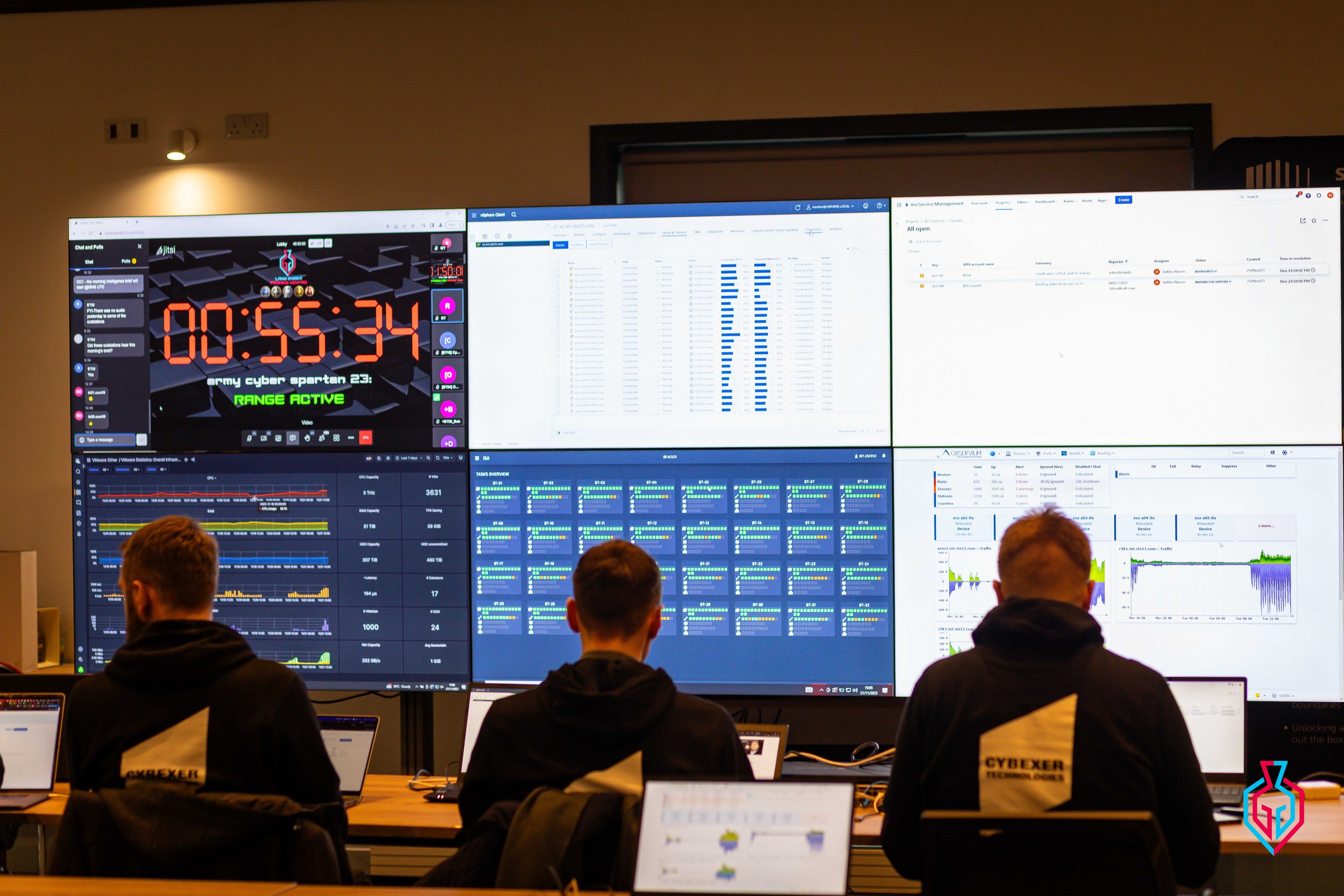
Every hunt runs on the CybExer Cyber Range, a high-fidelity digital twin of the systems, networks and protocols your team defends — seeded with a realistic intrusion for them to uncover. Because it mirrors your production environment rather than a generic lab, the traces feel authentic and the instincts your people build transfer straight back to the operations they protect, all with zero risk to live systems. Analysts hunt while instructors track every pivot and finding in real time.

N66A9402-2


0190 (1) 2


Hunts Designed and Led by Practitioners

Our scenarios are authored and led by people who have defended national infrastructure, run international cyber exercises and hunted real adversaries in live incidents. They plant a credible intrusion — matched to the threat groups that target your sector — and tune its subtlety to your team's maturity, from first-time hunters to seasoned SOC crews, calibrating the trail live so the hunt stays demanding without tipping into guesswork.

Why Threat Hunting Exercises Matter

1
Catch What Prevention Misses:

Firewalls and EDR stop the obvious; a capable adversary is built to evade them. Hunting is how teams find the intrusion that never triggered an alert — before it becomes an incident.

2
Cut Dwell Time:

The global median dwell time — the gap between compromise and discovery — rose to 14 days in Mandiant’s M-Trends 2026, and reaches 122 days for cyber-espionage intrusions. Practised hunters find attackers sooner.

3
Learn to Detect Internally:

Only 52% of intrusions are first spotted by the organisation itself; the rest are reported by outsiders. Regular hunting is how a SOC builds the muscle to find compromise on its own.

4
Compound Your Coverage:

Every hunt exposes a blind spot in your monitoring. Each exercise converts those findings into new detection rules, so the coverage you build grows with every session.

What Your Team Walks Away With

A detection capability is proven by what it catches, not by what’s in a runbook. Every exercise is built to deliver measurable improvement:

Reduce investigation time on live intrusions
Validate detection engineering before it reaches production
Strengthen hypothesis-driven hunting across the team
Identify visibility gaps across endpoints and networks
Increase analyst confidence against evasive adversaries
Reduce dwell time and mean time to detect
e-riigi-akadeemia-kuberturbe-oppus-6112025-foto-jakob-meier-30_54914050100_o

Build a Continuous Threat Hunting Programme

Hunting isn't a one-off. Develop a structured programme of exercises that progressively sharpens your team, validates each new detection and keeps pace with the adversaries actually targeting your sector.

Exercise → Lessons learned → Detection improvements → Validation → Repeat

Scored Live by ISA — and Repeatable on Demand

On the CybExer Cyber Range a hunt is never a black box. As your team works the incident — pivoting through telemetry, escalating findings and filing incident reports and situation reports — our NATO-awarded Integrated Scoring and Awareness (ISA) system captures every action and scores it live across availability, incident reports, situation reports and adversary activity. A White Team follows the same real-time picture, with AI Fabric automatically analysing submitted reports to sharpen and speed their assessment. Because the adversary is driven by our Breach Simulation Agent, the exact same hunt can be replayed on demand — so you can benchmark a team, retrain, and prove the improvement rather than assert it. Each exercise closes with an evidence-based after-action review that shows precisely where detection held, where it slipped, and what to harden before the real intrusion arrives.

See Every Pivot, Score Every Hunt

Every exercise on the CybExer Cyber Range is fully instrumented, so you can see exactly how the intrusion unfolds across your environment and how your team hunts it down. Trainers and managers get a clear, measurable picture of detection capability that turns each hunt into evidence of progress.

- See which systems and accounts the adversary touched and which your team uncovered

- Measure how quickly hunters detect and scope each intrusion

- Score performance and track improvement across repeated hunts

isa-scoreboard-vertical

Frequently Asked Questions

Everything you need to know about building proactive detection through hands-on threat hunting exercises on the CybExer Cyber Range.

Turn Every Exercise into Lasting Detection

A threat hunting exercise tests for more than whether one analyst spots one clue. Teams practise forming a hypothesis, pivoting through evidence, correlating weak signals across systems, identifying what seems malicious, and documenting what they find so it can be caught automatically next time. Whether you're exercising individual hunters, a full SOC shift or a joint IT/OT team, every pivot and finding is captured, measured and reviewed — turning each hunt into new detections and a sharper team.

DSC08542